From Contested Borders to a United Africa: The Lesson of the Eswatini–South Africa Dispute
The historical territorial claims associated with the Kingdom of Eswatini and the Republic of South Africa raise a fundamental question about Africa's past, present and future: how should a continent whose borders were largely shaped by colonial conquest, unequal agreements and external political interests deal with historical injustices without creating new conflicts between African countries?
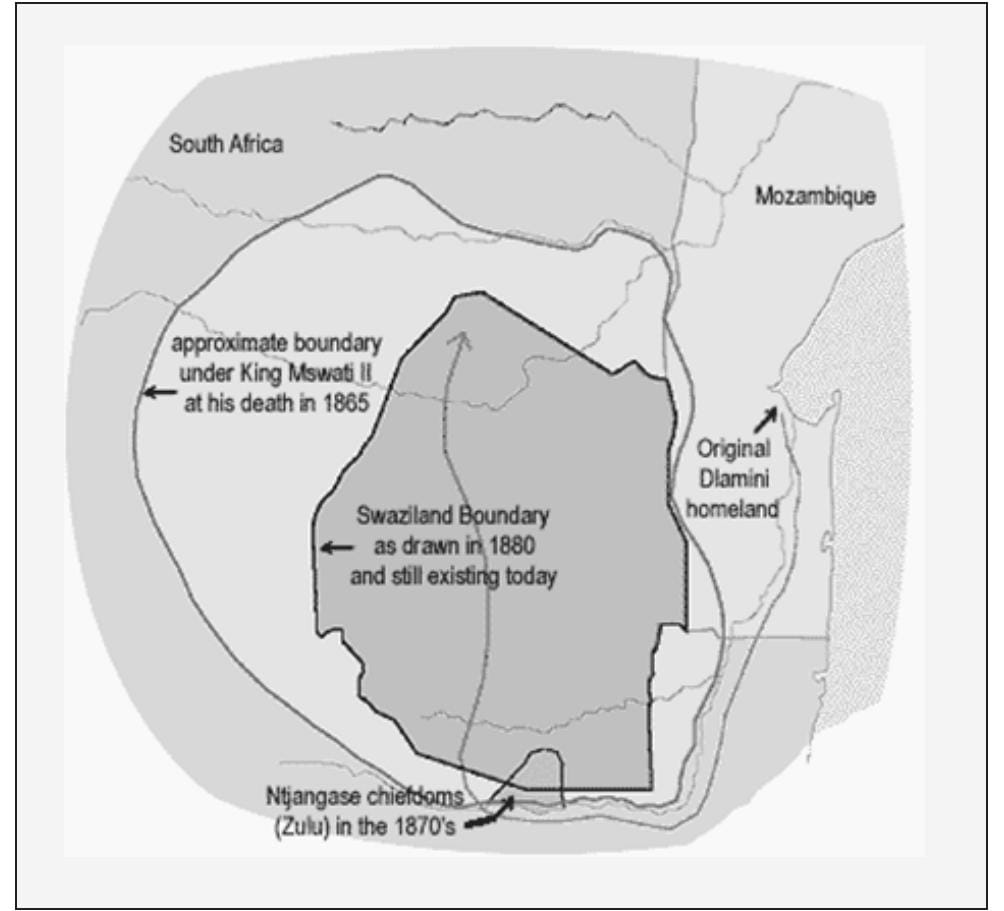
The history of the Swazi kingdom illustrates the complexity of this question. Historical maps suggest that the territory under Swazi authority in the nineteenth century extended beyond the boundaries of present-day Eswatini. The expansion of Boer and British power subsequently contributed to the division of historical Swazi territories and the establishment of borders that remain in place today. Different interpretations of historical agreements between Swazi rulers and European settlers have further complicated the debate over whether particular arrangements concerned land use, political authority or territorial sovereignty.
These historical questions deserve serious examination. The experiences of African communities whose lands and political structures were divided by colonial expansion should not be dismissed or forgotten. Nevertheless, historical grievances must be distinguished from contemporary legal rights. The fact that a kingdom once exercised authority over a particular territory does not, by itself, establish a present-day legal entitlement to that territory. Nor can historical agreements be interpreted conclusively without examining their context, terms and subsequent legal developments.
The challenge, therefore, is not simply to determine who controlled a particular piece of land a century or more ago. It is to establish how historical grievances can be addressed in a manner consistent with international law, the rights of affected populations and the preservation of peace between neighbouring African states.
In this respect, the African Union has established an important principle. Article 4 of its Constitutive Act recognises respect for the borders existing at the achievement of national independence, alongside the sovereign equality of member states and the peaceful settlement of disputes. The African Union Border Programme also provides a framework for addressing border questions through cooperation, negotiation and the peaceful management of boundaries.
These principles do not require Africans to forget their history or abandon historical research. Rather, they recognise that reopening territorial questions through unilateral action, political intimidation or military confrontation could create consequences far more destructive than the grievances they seek to resolve. If every African state were to advance territorial claims based solely on the historical extent of precolonial kingdoms, the continent could face an almost endless series of disputes, with serious implications for peace, development and regional cooperation.
The position I believe Africa should adopt is clear: all border and territorial disputes between African countries must be addressed through peaceful and diplomatic means, while the long-term solution to the continent's inherited divisions must be sought through deeper African integration.
In the specific case of Eswatini and South Africa, dialogue should take precedence over confrontation. Historical evidence can be examined by independent historians, legal experts and relevant institutions. If the two countries agree that a formal process is necessary, the African Union and the Southern African Development Community (SADC) could provide appropriate mechanisms for facilitation or mediation. Any process should respect international law, avoid prejudging the claims of either party and consider the interests and rights of the populations living in the territories concerned.
Yet even a peaceful resolution of this particular dispute would leave the broader African problem untouched. Across the continent, borders continue to separate communities with shared histories, languages, cultures, family ties and economic interests. They can obstruct trade, complicate mobility, divide pastoral communities and create unnecessary barriers to cooperation. These challenges cannot be overcome through endless debates about where borders should have been drawn in the past. They require a different political vision.
*That vision is African integration.*
SADC should progressively develop beyond an organisation primarily concerned with intergovernmental cooperation towards a more integrated regional community, with stronger common institutions, more effective dispute-resolution mechanisms, freer movement of people, deeper economic integration and coordinated development policies. Similar progress is necessary in other African regional communities, with the long-term objective of bringing these efforts together within a genuinely integrated African Union.
The African Continental Free Trade Area represents an important step towards an integrated economic space. However, economic integration alone is insufficient. Africa also needs stronger democratic institutions, the rule of law, common approaches to peace and security, and practical arrangements that enable citizens to benefit from regional cooperation. The African Union must increasingly become an institution capable not only of coordinating its member states but also of helping them overcome the historical and political divisions that continue to weaken the continent.
Full integration does not mean erasing national identities, abolishing cultural differences or imposing political uniformity. It means creating a framework in which national sovereignty can coexist with shared institutions and common responsibilities. It means that borders need not disappear physically for their divisive effects to diminish. When people can travel, trade, work, study and maintain family relationships across borders under agreed rules, territorial boundaries become less threatening and less politically charged.
This is particularly important for countries such as South Africa and Eswatini, whose populations have longstanding historical, cultural and economic connections. Their relationship should not be defined by competing interpretations of territorial history alone. It should be strengthened through trade, infrastructure, employment opportunities, cross-border mobility and common development initiatives that improve the lives of their citizens.
The same principle applies throughout Africa. Our continent cannot afford to remain trapped between the historical injustices of colonialism and the risk of reproducing those divisions through new territorial rivalries. We should acknowledge the past without allowing it to dictate an endless cycle of confrontation in the present.
A genuinely Pan-African approach would combine historical honesty with political pragmatism. It would recognise that colonial borders have often created real problems, but it would reject the idea that those problems can be resolved sustainably through unilateral territorial revision. Instead, it would seek democratic, legal and peaceful solutions to specific disputes while building regional and continental institutions capable of making borders progressively less consequential.
The ultimate objective should be an African Union that is not merely a gathering of sovereign states, but a community of peoples with shared democratic commitments, common economic interests and effective institutions of solidarity. Within such a union, historical disputes could be addressed without becoming existential struggles over national identity or territorial survival.
The lesson of the Eswatini–South Africa question is therefore much larger than the history of a particular kingdom or the interpretation of a particular boundary. It concerns the kind of continent Africans wish to build. We can continue to treat inherited borders as permanent sources of suspicion and competition, or we can work towards a future in which cooperation and integration progressively overcome their divisive effects.
Africa needs neither new territorial wars nor the denial of its history. It needs peaceful diplomacy in the present and political integration for the future. The strategic answer to the continent's historical divisions is not an endless redrawing of its map, but the creation of a united Africa in which its peoples can live in freedom, prosperity and solidarity, regardless of which side of a national border they happen to inhabit.
Adil Abdel Aati
20/10/2026