Building Our Own Tools
Why a continental alliance cannot wait to be given its technology
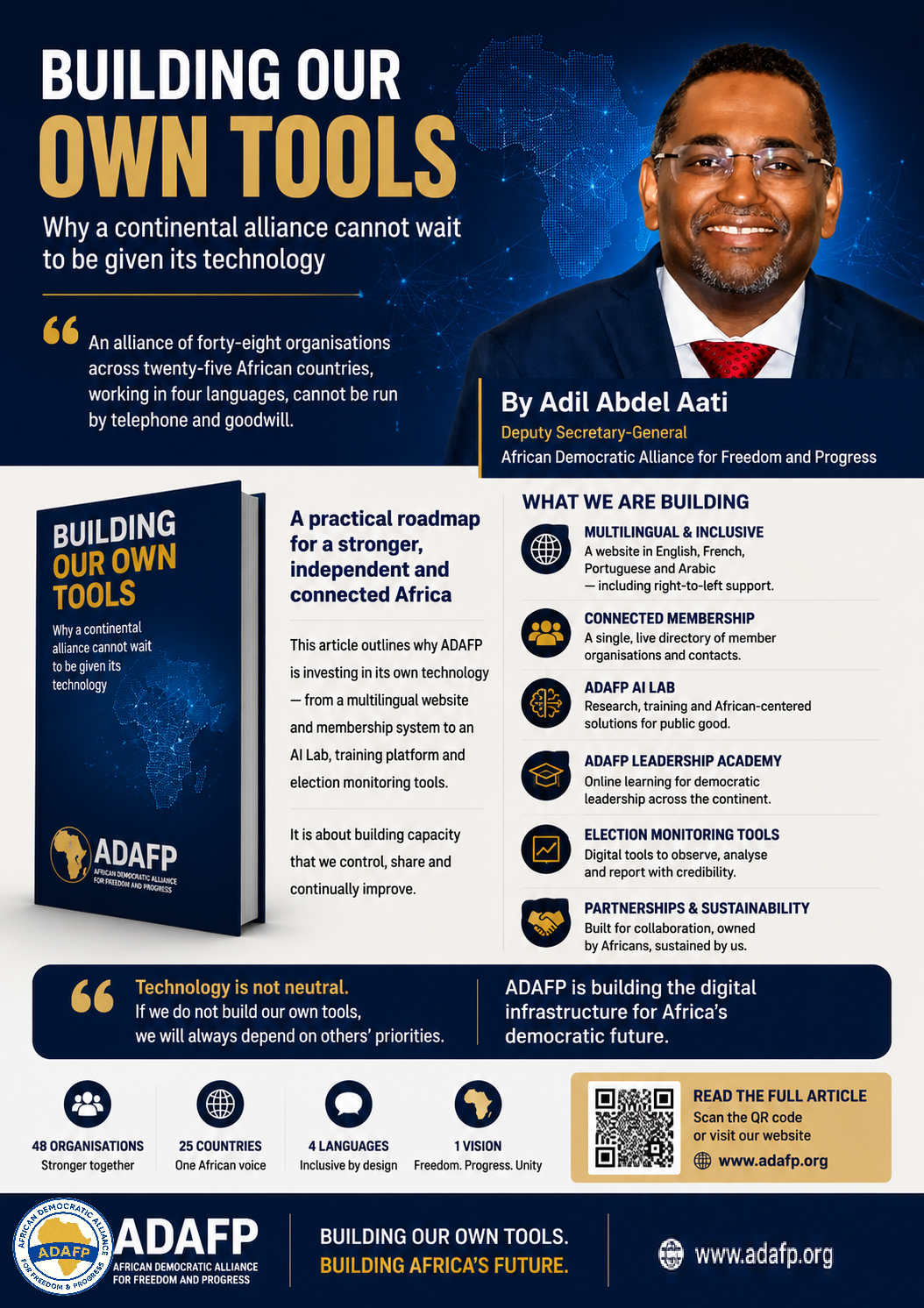
An alliance of forty-eight organisations across twenty-five African countries, working in four languages, cannot be run by telephone and goodwill. That is the plain fact from which everything that follows proceeds.
When ADAFP was founded in February 2026, we inherited the ordinary condition of most political organisations on our continent: a membership list that existed in three versions, none of them current; correspondence scattered across personal inboxes; a website that spoke to visitors in one language while our members worked in four. None of this was anyone’s failure. It is simply what happens when an organisation grows faster than its administration.
But for a continental alliance the cost of that condition is not merely inconvenience. A party in Chad and a party in Mozambique cannot learn from one another if neither knows the other exists. A statement issued in English reaches a fraction of the people it concerns. And an alliance that cannot say precisely how many parliamentary seats its members hold cannot make its case to anyone — not to funders, not to the African Union, not to its own members.
Distance is the permanent problem of pan-African organisation. It always has been. What is new is that technology has become cheap enough, and capable enough, that a modestly resourced alliance can now do things which twenty years ago required a secretariat of fifty people.
What we learned from others
We did not invent this idea, and we should say so plainly.
Our first inspiration was DemTools, the initiative of the National Democratic Institute’s technology team. From around 2014, NDI built and gave away open-source software for democratic actors — election monitoring, contact management, petitions, issue tracking — and hosted it for partners who had no means of running it themselves. Their insight was that the tools available to activists and parties in the developing world were either poor, or too expensive, or demanded skills that were not there. So they built better ones and gave them away.
I mention DemTools with a second observation, which is as instructive as the first. In 2021 the initiative was reoriented from a suite of tools NDI itself maintained into a catalogue of tools recommended from elsewhere, most of them other people’s. Its public site has published nothing since the summer of 2022.
I say this with no criticism of NDI, whose work has been of real value to democratic organisations across the world, including in Africa. But it illustrates something we should take seriously. A technical capacity that rests on another institution’s programme priorities is a capacity you do not control. Funding cycles end. Priorities move. The tools remain useful; the initiative that made them available did not remain. If we want instruments that are still working in ten years, some part of the ability to build and maintain them has to sit inside African organisations.
Our second was the Observatory of Public Sector Innovation at the OECD, which studies how public institutions actually change — not through grand strategies, but through practical experiment, documented carefully so that others can learn from it. It is a habit of mind more than a set of tools: try something small, record honestly what happened, share it.
The two are connected: OPSI’s own library catalogues DemTools. That circulation of practical knowledge is what we want ADAFP to be part of — not as a recipient only, but in time as a contributor. An African alliance that documents honestly what it built, what it cost and what failed would be adding something to that record which is presently thin.
We began small
We started with what was immediately broken.
The first piece was a new ADAFP website, rebuilt from the ground up. It carries every page in English, French, Portuguese and Arabic — including right-to-left display for Arabic, which is not a detail if you expect Sudanese and Egyptian members to feel the alliance is theirs. Behind it sits an administration system through which our secretariat publishes statements, articles, events and documents in all four languages without needing a developer. The membership directory, which had lived in three contradictory versions, is now a single record from which the figures on our homepage are drawn directly. When we approve a new member, the number changes by itself.
Alongside it we run a customer relationship management system — the same category of software a company uses to track its clients, turned to our own purposes: individual contacts as distinct from member organisations, correspondence, partnership pipelines.
Then came the ADAFP AI Laboratory, which is our workshop. It brings artificial intelligence tools to our members’ daily work: assistance with research and drafting, translation across our four languages, plain-language summaries of legislation, a claim-checking tool that returns evidence and sources rather than a verdict, and a tracker for promises made by those who hold office. The Laboratory is also where our AI Ethics Charter was developed, because an organisation that uses these tools without thinking about their limits will eventually be embarrassed by them.
We built a platform for the Continental Youth Forum of Political Parties, because a youth network without its own presence is a youth network in name.
Elections: where the work becomes serious
Our most substantial effort is in election technology, and it is deliberately built as separate instruments for separate purposes.
The first is a toolkit for member parties to protect their own vote on polling day. It records where a party’s agents are deployed, what they report from each polling station, and what result was posted at each one — so that a party can compare what was counted against what is later announced. It is designed to work on an ordinary mobile telephone, without internet, because that is what most polling agents in Africa actually carry. Reporting that a station has opened takes three keypresses.
The second is the observation platform of our Election Monitoring and Observation Department. It is a different system entirely, and that separation is not accidental. EMOD’s findings are worth something only if they are visibly independent of the parties in the contest. Its observers sign a declaration of impartiality before the system will accept a single report from them. Its observation samples are drawn at random before polling day, and the draw is recorded so that anyone may verify it afterwards. Where a mission conducts a parallel vote tabulation, the platform estimates each candidate’s share with a stated margin of error — and says plainly what such an estimate cannot prove.
A third instrument, a public channel for citizens to report incidents, is in preparation. We expect to build it on Ushahidi, the platform born in Kenya after the violence of 2007 and 2008, rather than build our own. Where an African solution already exists and works, we should use it.
Turning the tools on ourselves
One project now under way deserves particular mention, because it shows what these methods are for.
We are conducting an assessment, assisted by artificial intelligence, of the online presence of every ADAFP member organisation — whether each has a working website, whether it is reachable, whether it is visible to someone searching for it. The findings have been instructive, and in some cases uncomfortable. A number of our members have no web presence at all. Others have one that is, in practical terms, invisible: a social media page that shows a login prompt to anyone not already signed in, and which no search engine can index. Some are paying for domain names that display nothing.
We are not publishing which members these are, and we do not intend to. The purpose is not to rank our own membership but to help it. A programme is being prepared to give every member a proper profile within the alliance, to build simple sites for those with none, and — for members in good standing — to fund independent domains registered in their own name, not ours. A party that depends on ADAFP for its identity is not strengthened by ADAFP.
What we intend, and what it will require
What exists today was built with very modest resources. What comes next requires two things we do not yet have: a permanent technical team, and funding to sustain it. I set out our ambitions here not as promises but as a direction of travel, so that members and partners understand what we are working towards.
For our member parties, we intend dedicated systems for the management of a political organisation — membership, communications, finance and planning — built for African parties rather than adapted from software designed for European corporations.
For members who reach government, an e-government portal: the machinery through which a party in office can deliver services to citizens transparently. It is one thing to win an election; it is another to govern well, and the second is where liberal parties are most often judged and found wanting.
Beyond that, and further out, sit the projects that a serious continental technical capacity would make possible. Systems for the management of health, education, agriculture and energy — the sectors on which African development actually turns. African-language artificial intelligence models, because a continent whose languages are absent from these systems will be a consumer of other people’s technology indefinitely. An African operating system, so that our public institutions are not permanently dependent on software written elsewhere and licensed at prices set elsewhere.
And a project to which ADAFP has already given serious thought: an African digital currency, developed alongside our proposal for a continental monetary institution. Monetary sovereignty is not a technical question. It is the question on which a great deal of African economic independence rests.
I am aware how these ambitions sound set against what we have so far built. I state them anyway, because an organisation that does not say where it intends to go will never be given the means to get there.
What I ask of our members
Technology will not win an election, draft a policy, or persuade a voter. It does none of the things that politics actually consists of. But it determines how much of your effort survives contact with the ordinary difficulties of distance, language and scale.
So I ask three things of our member parties and their leaders.
First: use what already exists. Our tools are available to you, at no cost, and they are of no value sitting unused. If your party has no website, tell us. If your only presence is a personal social media page, tell us that too — it is precisely the problem we are trying to solve, and there is no disadvantage in saying so.
Second: put someone in charge of it. Not a technical specialist, necessarily, but a person whose responsibility it is. Every organisation that has made progress in this area did so because one person owned the problem.
Third: engage with artificial intelligence seriously, and neither dismiss it nor be dazzled by it. These systems are genuinely useful for translation, for research, for drafting, for making sense of long documents in a language that is not your first. They are also confidently wrong at times, and they are built by others, in other places, reflecting other assumptions. Both things are true. A party that refuses to use them will be at a disadvantage; a party that trusts them without checking will eventually publish something false. Use them, and verify.
Africa will not be given the technology it needs on terms that suit it. Every serious continental project of our generation — monetary, industrial, democratic — runs into the same wall: we do not control the infrastructure on which it would have to run.
ADAFP is a young alliance with limited means. We are not going to solve that. But we can demonstrate, on a small scale and in our own work, that African democratic organisations are capable of building their own instruments rather than waiting to be handed them. We have begun. The invitation to our members is to build the rest with us.